
How the ‘Why’ of a Business Can Make or Break a Customer Base
Simon Sinek is an author and speaker who has transformed countless organisations with his idea of ‘the golden circle’. The golden circle consists of three layers, one inside another. The inner most is why, the second layer how and the third what. Every organisation knows what they do very well. Some know how; whether that be a proprietary process or a unique selling point. But only a few know why they do what they do. The ‘why’ is their purpose, their reason for existing and their beliefs.
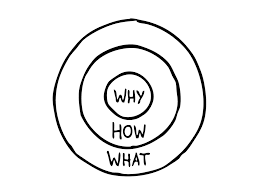
The Golden Circle
To understand what this represents let’s look at a real life example: Apple. If Apple sounded like every other average company selling technology, they would probably sound like this: we make great computers, it is beautifully designed, simple to use and user friendly. This approach starts with what, then how without much of a why. It’s the way most people talk, how most organizations sell and market their products and how most digital marketing is done. But that didn’t make you want that product let alone feel hooked enough to check it out. That was generic and didn’t really appeal to their target audience. If that’s the case then what are you supposed to do to hook your customers? What does Apple do differently that allows them to dominate the industry so well? The answer is simpler than you think.
Let’s look at how Apple actually sounds like: Everything we do, we believe in challenging the status quo, in thinking differently. The way we challenge the status quo is by making our products beautifully designed, simple to use and user friendly. We just happen to make great computers. Want to buy one?
What was the difference here?
Just one simple yet fundamental change. Start with why. Why is the innermost circle and the most important though many neglect it. Just by reversing that order, the message sounds interesting, memorable and most importantly makes the customer want to buy it.
“People don’t buy what you do, they buy why you do it”.
This is the reason why we are comfortable buying airpods, ipads and watches from Apple even though they are a computer company. There are certainly many others who are just as qualified or more so to sell these things. But nobody bought products from these companies. People don’t buy what you do, they buy why you do it.
Simon explains that the goal is not to do business with everyone who needs what you have, it’s to do business with those who believe in what you believe. The answer to why this works is hidden in the biology of how the human brain works. The human brain is split into three main components that parlay perfectly with the three parts of the circle. Our homosapian brain, the neocortex, corresponds with the ‘what’ layer. Our limbic brains are responsible for how and why and it manages behaviour. But it has no capacity for language. This means how and why are not understood through statistics and logic. The homosapien brain does that. Which is why when you start with what or in other words with statistics, it doesn’t drive behaviour. And that is why when you start with ‘why’, it drives straight into the limbic brain and influences behaviour. This allows the brain to rationalize after understanding the why, going from why to how to what. This is the gut feeling that causes people to say ‘I just have a feeling’ or ‘it just feels right’ or when you ‘lead with your heart’ or soul. It’s because the why has been justified and then rationalized. Because it targeted the part of the brain that controls decision making/ behaviour and not language.
However if you don’t know why you do what you do then you can’t expect anyone to buy your product, vote for you or be loyal to you? What would make them want to be a part of whatever it is that you do?
If you hire people just because they can do their job they will work for your money. If you hire people that believe in what you believe they will spend blood, sweat and tears to do the work and to do it well.
The Wright Brothers
An example of this is the Wright brothers. In the 20th century, similar to how common trying to make a website is in the 21st century, everyone was trying to build a man powered contraption to fly the skies. Samuel Pierpont Langley had everything to make this dream come true.
When we ask any organisation why a product or company failed, it comes down to three things:
-Lack of capital
-The wrong people
-Bad market conditions
Let’s explore that through Samuel’s story. He was given 50,000 dollars by the war department to build this machine capable of flight. He had a seat in Harvard and worked at the Smithsonian, he was an extremely well-connected individual. He knew the brightest minds in the industry and hired the best money could find. The market conditions for this pursuit were perfect. The New York Times followed his every move and the public were rooting for his success. Then how come we have never heard of Samuel Pierpont Langley?
A few hundred miles away, in Dayton, Ohio, was Orville and Wilbur Wright. They had none of these ingredients for success. No abundance of military funded money, no connections to the brilliant individuals in Harvard and Smithsonian, no one knew them. They paid for their dream through the meager earnings from the bicycle shop. Not a single person on the Wright brothers team, including Orville and Wilbur, had a college education.
The one factor that set the Wright brothers apart from the infinitely more qualified team with Samuel was their “why”. Their drive, purpose and need came purely from the belief that if they figured out this flying machine, it would change the course of the world. Samuel on the other hand wanted riches and fame. His pursuit was for the result, the riches and recognition. The individuals who worked on the Wright brothers team worked with their blood sweat and tears, not for money but because they believed in the Wright brothers dream. Samuel’s team worked for a paycheck. That paycheck does not require blood and sweat and tears and could never warrant that. They tell stories of how every time the Wright brothers went out they would carry five sets of parts because that’s how many times they would crash before supper. Eventually on December 17, 1903, the Wright brothers took flight, with no one to record or spread the celebration of this feat. It took a few days for news to reach the public. To prove even further the misdirection of Samuel’s drive, he quit on the day the Wright brothers took flight. Instead of acknowledging the incredible feat the brothers had accomplished and striving to improve it, he quit. Because there was nothing left for him in it. He was not the first, he didn’t get rich and he didn’t get famous. People buy what you do, they buy why you do it. If you talk about what you believe, it will attract people who believe in what you believe. Why is that important?
The Law of Diffusion Of Innovation
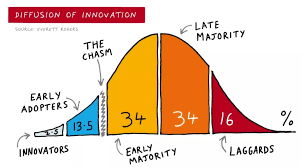
The law of diffusion of innovation explains it. It divides our population into a set of groups. The first two and a half percent of our population are our innovators. The next thirteen and a half percent of our population is our early adopters. The next thirty four percent is our early majority, thirty four percent late majority and sixteen percent laggards. All of us will sit in different areas in this scale in different times but what the law of diffusion of innovation tells us is that if you want mass-market success then you need to achieve a tipping point between fifteen and eighteen percent market penetration and then the system tips in your favor. The early majority will not try something unless they have seen someone else do it. That is where the innovators and early adopters come in. These are people who waited in line for hours to get an iphone when they first came out. These people are comfortable making gut decisions to try something so that they can be the first, to be viewed as the first by society. What you do proves what you believe.